
Esalen: Unleashing the Power of Human Potential

Esalen isn’t just a place on the California coast. It’s a living experiment in what humans can become when they stop performing and start being. Since 1962, this 120-acre retreat nestled above the Pacific has drawn people from every walk of life-not to escape, but to awaken. You don’t go to Esalen to relax. You go to unravel.
What Esalen Actually Is
Esalen Institute is a nonprofit center for study and personal transformation. It sits on 120 acres of rugged coastline in Big Sur, California, where hot springs bubble up through redwood forests and the ocean crashes against cliffs below. But it’s not a spa. It’s not a resort. It’s a laboratory for human experience.
Founded by Michael Murphy and Dick Price, two Stanford graduates tired of academic detachment, Esalen was built on a simple idea: if you want to change how people live, you have to change how they feel. They invited psychologists, poets, dancers, Zen masters, and mystics to lead workshops that blurred the lines between therapy, philosophy, and art.
Early guests included Carl Rogers, Alan Watts, and Fritz Perls-the people who shaped modern psychology. Perls developed Gestalt therapy right there on Esalen’s wooden floors. The institute didn’t just host ideas; it let them breathe, sweat, scream, and cry.
The Birth of the Human Potential Movement
Esalen gave name to the Human Potential Movement. This wasn’t a marketing slogan. It was a radical belief: every person carries unused capacities-creativity, empathy, intuition, resilience-that society trains out of us. Esalen said: what if you could reclaim them?
Workshops weren’t about fixing problems. They were about unlocking what was already there. A man who couldn’t speak in public might spend three days lying on a mat while others held space for his silence. A woman who felt numb might dance barefoot in the rain until tears came. There were no quick fixes. Only deep, messy, honest encounters with yourself.
Unlike today’s self-help gurus selling 30-day challenges, Esalen didn’t promise results. It offered presence. And presence, over time, changes everything.
How Esalen Changed Therapy-and the World
Before Esalen, therapy was mostly talk. Sitting on a couch. Analyzing childhood. Esalen introduced movement, touch, breathwork, and sensory awareness into healing.
Bodywork became central. Massage wasn’t just for tension-it was for releasing stored trauma. Bioenergetics, a form of body-centered therapy, taught people to feel their emotions in their muscles. If you were angry, your jaw clenched. If you were afraid, your belly tightened. Healing meant learning to release those patterns.
Group therapy at Esalen didn’t follow rules. There was no therapist in charge. People spoke from the heart. Someone might cry. Another might sit silently. No one was told to stop. No one was judged. That was revolutionary. Today, many trauma-informed practices trace their roots back to those raw, unstructured sessions.
Even mindfulness-now a billion-dollar industry-started here. Before apps and podcasts, people sat in silence on Esalen’s stone benches, watching waves, noticing thoughts without chasing them. That practice didn’t come from Buddhism alone. It came from trial, error, and real human need.
What Happens at an Esalen Workshop Today
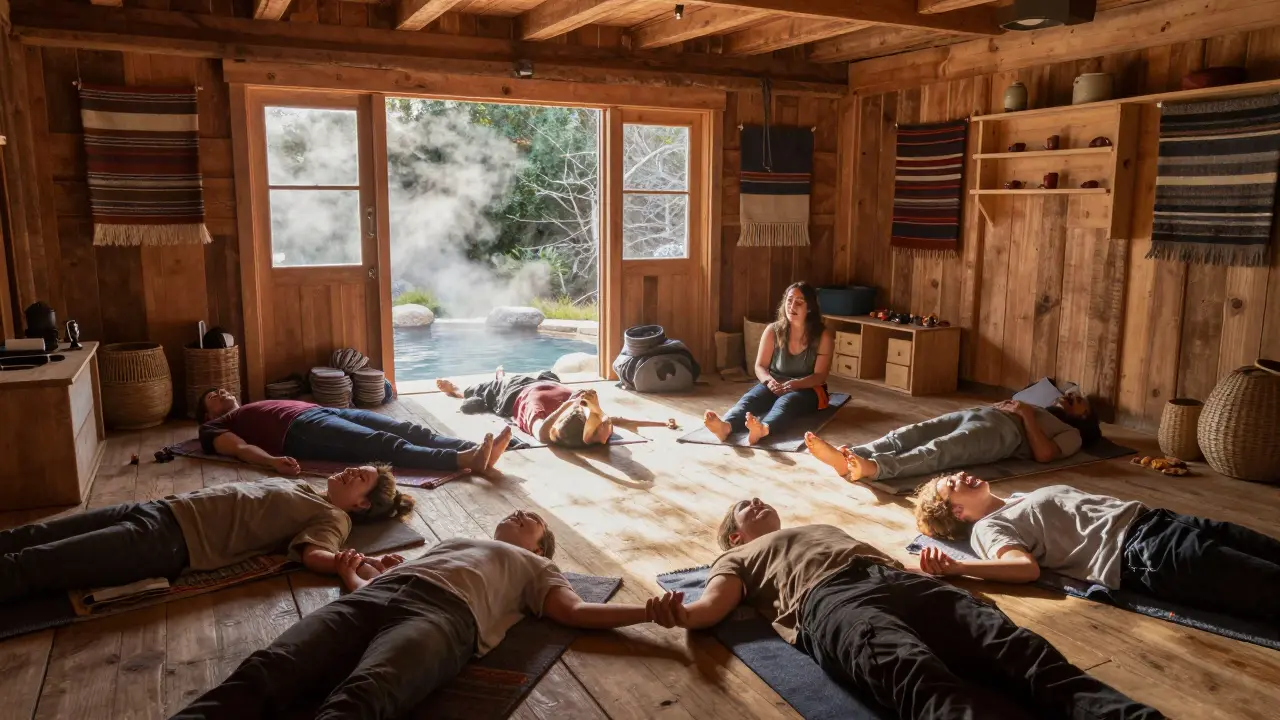
Esalen still runs over 200 workshops a year. You’ll find yoga with Tibetan monks. Poetry nights under the stars. Somatic experiencing for veterans. Sound baths with crystal bowls. Dreamwork circles. Even workshops on death and dying.
There’s no agenda. No schedule that forces you to move from one thing to the next. You wake when you’re ready. Eat when you’re hungry. Sit in the hot springs as long as you want. The structure is loose on purpose. It’s meant to slow you down.
One common thread? The work is physical. Even when it’s about emotion, it’s felt in the body. A workshop on grief might start with journaling, then move to breathwork, then to guided movement where you let your arms flail like wind. No one tells you what to feel. You just feel it.
Many leave with no grand epiphany. Just quiet. A sense of being less alone. That’s the magic. Not transformation as a spectacle-but transformation as a slow unfurling.
Why Esalen Still Matters in 2026
We live in a world of speed. Notifications. Productivity hacks. Digital detoxes that are just another app. We’re told to optimize ourselves. To become better versions of who we are.
Esalen doesn’t believe in better versions. It believes in deeper presence.
In 2026, people are more anxious, more disconnected, more exhausted than ever. But they’re also more hungry for real connection-for silence, for touch, for authenticity. Esalen offers none of the shiny tools. No AI coaches. No tracked progress. Just a place where you can sit with your pain, your joy, your confusion-and not be fixed.
That’s rare. And that’s why people still travel across the world to sleep in simple cabins, eat vegetarian meals in silence, and walk the cliffside paths with strangers who become friends.
Esalen doesn’t sell enlightenment. It offers space. And in that space, people find what they’ve been looking for all along: themselves.
The Cost and the Choice
Attending a workshop at Esalen costs between $800 and $2,500, depending on length and type. Accommodations range from shared rooms to private cabins. Meals are included. Transportation is not.
It’s expensive. And that’s intentional. The cost filters out those who treat it like a vacation. Those who come are usually ready to change something real.
There’s also a scholarship program for people who can’t afford it. The institute believes transformation shouldn’t be a privilege. But the truth? Most who benefit are those who’ve already hit a wall-people burned out from corporate life, parents who’ve lost themselves, veterans carrying invisible wounds, artists who’ve forgotten why they create.
If you’re wondering whether it’s worth it, ask yourself: have you ever sat still for more than five minutes without reaching for your phone? If not, maybe you’re already halfway there.
Who Should Go-and Who Shouldn’t
Esalen isn’t for everyone. If you want quick answers, structured programs, or spiritual guarantees, you’ll leave frustrated.
It’s for people who:
- Feel stuck but don’t know why
- Crave silence but don’t know how to sit with it
- Are tired of being told what to do
- Feel disconnected from their bodies
- Need to feel something real again
It’s not for people who:
- Expect a miracle in three days
- Want to be told they’re special
- Need to be entertained
- Are afraid of their own emotions
The hardest part? Coming home. The world doesn’t stop. Jobs don’t pause. Relationships don’t wait. But what you carry back? That changes how you move through it.
The Legacy of Esalen
Esalen didn’t invent personal growth. But it gave it soul. It took ideas from psychology, Eastern philosophy, and indigenous traditions and made them alive-not theoretical, not academic, but lived.
Today, you’ll find echoes of Esalen everywhere: in mindfulness apps, in yoga studios, in therapy practices that focus on the body, in retreat centers that promise "inner peace." But few still hold the raw, unfiltered honesty that made Esalen revolutionary.
It’s not about the hot springs. Or the view. Or even the workshops.
It’s about the quiet moments-when you’re alone on the path, the wind hits your face, and for the first time in years, you feel completely, simply, human.