Mastering the Techniques of BDSM Massage: Safety, Consent, and Sensation Play
Most people think of massage as something relaxing - warm oil, soft music, gentle pressure. But BDSM massage is something else entirely. It’s not just about touch. It’s about control, trust, and the sharp edge between pleasure and pain. If you’re curious about BDSM massage, you’re not alone. More people are exploring it as a way to deepen intimacy, test boundaries, or simply feel alive in ways they never expected. But it’s not about grabbing a whip and going wild. It’s a practice built on skill, communication, and deep respect.
What Exactly Is BDSM Massage?
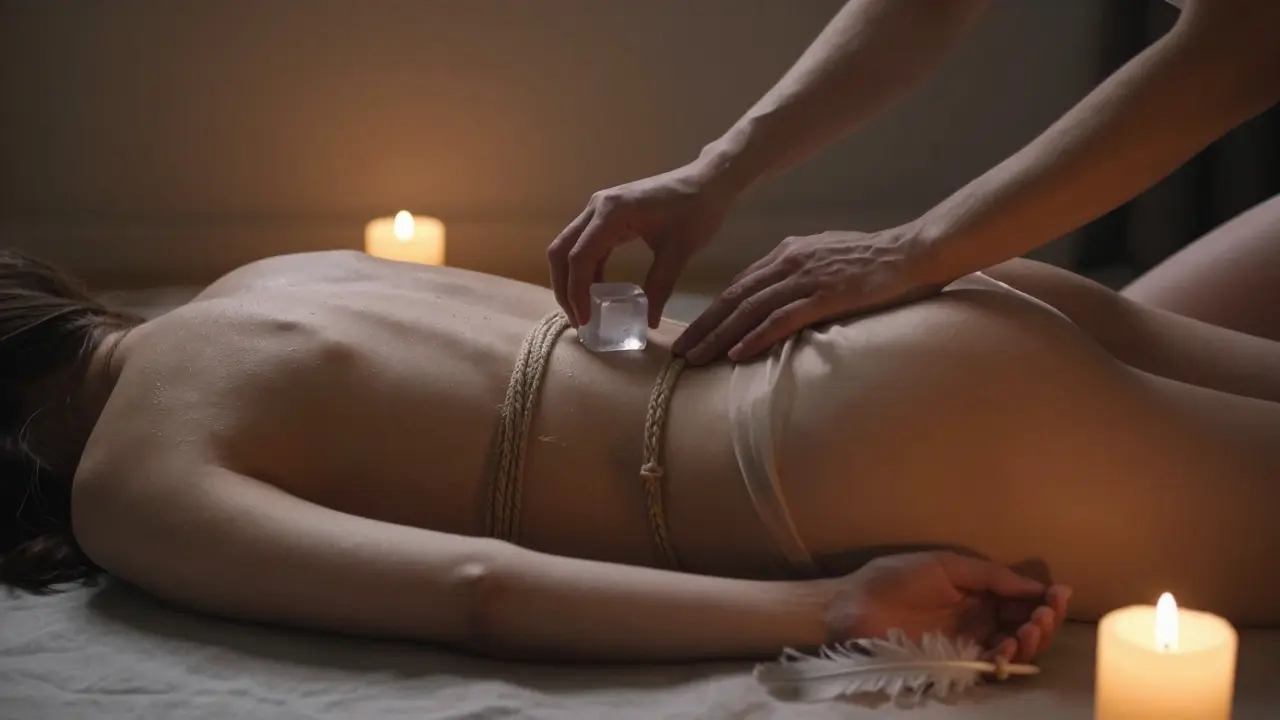
BDSM massage blends traditional massage techniques with elements of bondage, dominance, submission, sadism, and masochism. It’s not one thing. It can be slow and sensual, using silk ropes and ice cubes. Or it can be intense, with paddles, floggers, and sensory deprivation. The key? Every sensation is intentional. Every touch is negotiated.
Unlike erotic massage, which often focuses on arousal and orgasm, BDSM massage is about exploring power dynamics and sensation. It might involve restraining someone to heighten vulnerability. Or it might mean using a feather to trace lines across skin until the person can’t tell if it’s pleasure or torture. The line between pain and pleasure isn’t just blurred - it’s redefined.
Studies from the Journal of Sex Research show that people who engage in consensual BDSM report higher levels of trust and communication in their relationships. That’s not luck. It’s practice. And massage is one of the most accessible entry points.
The Three Pillars: Consent, Communication, and Control
You can’t skip these. Not even a little.
Consent isn’t a one-time yes. It’s ongoing. Before any session, talk about limits. What’s off-limits? What’s a hard no? What’s a soft yes - something you’re curious about but not sure about? Use clear language. Say: "I’m okay with being tied up, but not with verbal humiliation." Or: "I like the feeling of pressure, but not sharp pain." Write it down if it helps. Review it before every session.
Communication happens during the session too. Use safewords. Not "no" or "stop." Those can be part of the scene. Use a word like "red" for stop, "yellow" for slow down, "green" for keep going. Make sure both people know them. And check in. Ask: "How’s the pressure?" "Is this too much?" "Do you want more?" Silence doesn’t mean consent. It might mean shock, overwhelm, or dissociation.
Control is the engine. The dominant sets the pace. The submissive gives up control - but only because they trust the other person to hold it safely. That’s the magic. Not the tools. Not the intensity. The trust.
Tools of the Trade: Beyond the Whips
You don’t need a dungeon to start. Many tools are everyday items repurposed with intention.
- Waxed cotton rope - soft, strong, and warm. Perfect for tying wrists or ankles without cutting off circulation.
- Feathers and silk - for light, teasing touch. Great for building anticipation.
- Ice cubes - slowly melt on skin. The contrast between cold and warmth can be mind-bending.
- Warming oils - not just for heat. A slow rub with a warming blend can make skin tingle for minutes.
- Blindfolds - remove sight, and every touch becomes louder. A brush of fingers feels like a shock.
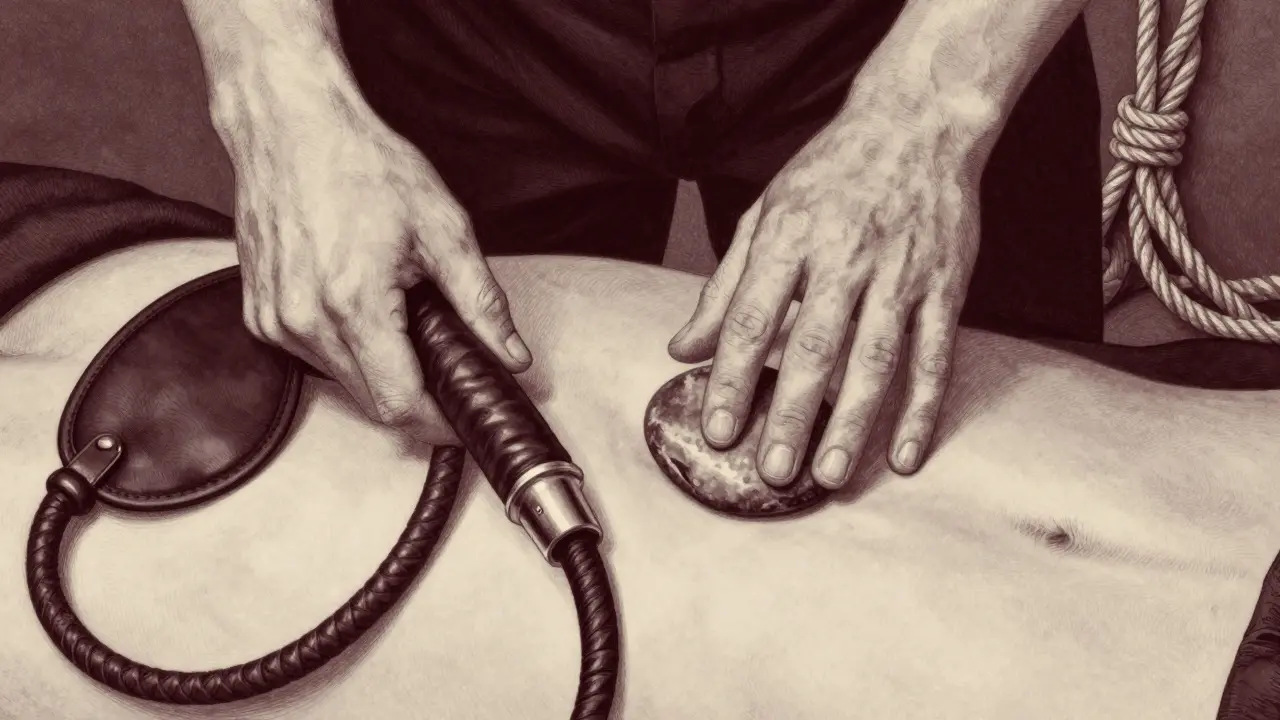
- Whips and floggers - start with soft leather. Practice on a pillow first. Learn how to swing so the impact lands flat, not sharp.
- Clamps and pins - use rubber-tipped ones. Start with low tension. Let the body adjust.
Never use metal, glass, or anything sharp on skin without training. Never use household items like duct tape or plastic ties. They can cause injury. BDSM tools exist because they’re designed for safety. Use them.

Sensation Play: How to Play with Pain and Pleasure
Sensation play is the heart of BDSM massage. It’s not about hurting. It’s about rewiring how the body experiences touch.
Try this simple sequence:
- Start with deep, slow massage. Warm the body. Build trust.
- Switch to cold - an ice cube dragged slowly across the back. Watch how the skin reacts.
- Then heat - a warmed stone held gently against the spine.
- Now, contrast: one hand cold, the other warm. Let the person feel both at once.
- Add sound: a soft whisper in the ear. A tap on the shoulder. A slap on the thigh - not hard, just firm.
- End with silence and stillness. Let them feel their own body again.
This isn’t random. It’s a rhythm. You’re teaching the nervous system to reinterpret sensation. What starts as discomfort can become ecstasy. That’s the transformation.
One woman I spoke to in Adelaide said: "I used to hate being touched unexpectedly. After six sessions of sensation play, I started craving it. It wasn’t about pain. It was about being seen - really seen - in my body."
Aftercare: The Most Important Part
Many people skip this. Big mistake.
After a session, the body and mind are vulnerable. You might feel drained, emotional, or even numb. That’s normal. Aftercare is the reset button.
- Wrap them in a warm blanket.
- Offer water. Or tea. Something soothing.
- Hold them. No pressure to talk. Just presence.
- Ask: "What do you need right now?" Not "How was it?" That’s a question for later.
- Check in the next day. A simple text: "Thinking of you. How are you feeling?"
Aftercare isn’t fluffy. It’s essential. It’s how you repair the emotional bridge you just crossed. Skip it, and you risk trust breaking.
Common Mistakes and How to Avoid Them
Even experienced people mess up. Here’s what goes wrong - and how to fix it.
- Mistake: Assuming "no means yes." Fix: If someone says "no," stop. Period. No exceptions.
- Mistake: Ignoring physical signs. Fix: Pale skin, rapid breathing, trembling, or freezing up aren’t "turn-ons." They’re red flags. Pause. Check in.
- Mistake: Using too much intensity too soon. Fix: Start slow. A light tap. A single rope. One new sensation per session.
- Mistake: Forgetting hygiene. Fix: Clean tools after every use. Wash hands. Use barrier protection if there’s skin contact near mucous membranes.
- Mistake: Not having a plan for emergencies. Fix: Keep scissors nearby for quick rope release. Know where the first aid kit is. Have a phone charged and ready.
Who Should Try This - and Who Shouldn’t
BDSM massage isn’t for everyone. And that’s okay.
It’s a good fit if you:
- Value deep communication with your partner
- Are curious about power dynamics in a safe way
- Can sit with discomfort without panicking
- Are willing to learn, not just experiment
It’s not a good fit if you:
- Feel pressured to try it
- Use it to escape trauma without therapy
- Think pain = love
- Can’t say "no" without guilt
If you’re recovering from abuse, trauma, or have PTSD, talk to a therapist first. BDSM isn’t a substitute for healing. It can be part of it - but only with support.
Where to Learn More
Books like The New Topping Book by Dossie Easton and Janet W. Hardy, or The Ethical Slut by Dossie Easton and Catherine A. Liszt, offer clear, practical guidance. Local workshops in Adelaide and Melbourne run monthly. Look for groups like "Sensory Play Adelaide" or "Bondage & Beyond."
YouTube isn’t enough. Watch videos for inspiration, not instruction. Real learning happens in person - with feedback, correction, and safety checks.
Is BDSM massage the same as erotic massage?
No. Erotic massage focuses on arousal and sexual release. BDSM massage focuses on sensation, control, and emotional dynamics. It may lead to orgasm, but that’s not the goal. The goal is exploration - of trust, boundaries, and sensory experience.
Can I do BDSM massage alone?
Not really. BDSM relies on interaction - power exchange, trust, communication. Solo play can involve sensation tools, but it’s not BDSM massage. It’s self-exploration. BDSM requires a partner.
What if I like the pain but my partner doesn’t?
That’s fine. Not everyone has to enjoy the same things. You can explore different styles - one person enjoys being tied up, the other enjoys giving gentle pressure. The key is mutual respect. You don’t have to do the same things. You just have to honor each other’s limits.
Do I need special equipment?
No. You can start with household items: a silk scarf for tying, ice cubes, a feather duster. But as you go further, invest in proper tools - soft ropes, silicone floggers, padded restraints. They’re safer and more effective. Avoid anything that can cut, crush, or restrict breathing.
How do I know if I’m doing it right?
You’re doing it right if both people feel safe, respected, and connected. If you’re both talking afterward - laughing, sharing, checking in - you’re on track. If one person feels used, confused, or shut down, stop. Go back to basics. Communication always comes before intensity.
Final Thought: It’s Not About Power - It’s About Presence
BDSM massage isn’t about domination. It’s about deep attention. It’s about noticing the way someone’s breath changes when you run your fingers along their collarbone. It’s about holding space for someone to feel something they’ve never allowed themselves to feel before.
The most powerful tool you have isn’t a whip. It’s your voice. Your hands. Your willingness to listen - even when the silence is loud.